
The Tactical Logic Behind 8th Air Force Bomber Groups
To a modern eye, the sight of hundreds of heavy bombers flying in tight, rigid formation seems almost perverse. Surely the logic of survival would be to scatter — to make each aircraft a harder target, to deny enemy fighters a concentrated killing ground. The men of the 8th Air Force understood this instinct perfectly. They also understood why it was wrong. The formation was not a vulnerability. It was the entire basis of their survival.
The Problem of Daylight Bombing
When the United States Army Air Forces committed to a policy of daylight precision bombing in 1942, they were choosing a path the Royal Air Force had already abandoned after catastrophic early losses. The RAF had switched to night bombing precisely because unescorted bombers in daylight were massacred by German fighters. The Americans believed they had the answer: the B-17 Flying Fortress.
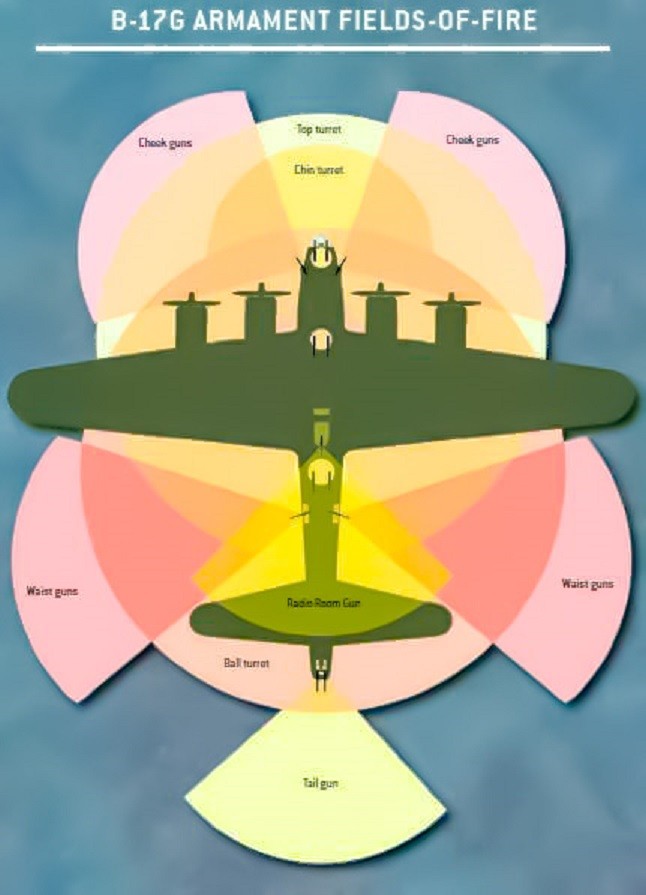
The B-17G — the variant that the 487th flew from Station 137 — carried thirteen .50 calibre machine guns covering virtually every arc around the aircraft. Top turret, chin turret, cheek guns, waist guns, ball turret, radio room gun, tail gun. On paper, a single B-17 was a formidable defensive platform. In practice, it was not enough. A lone B-17 could be attacked from any direction by fighters choosing their angle carefully to avoid the most dangerous gun positions. The answer was to fly many B-17s together, so that the fields of fire of every aircraft overlapped with those of its neighbours, creating a defensive envelope that no single fighter could penetrate without flying through sustained .50 calibre fire from multiple aircraft simultaneously.
The Building Blocks — Element, Squadron, Group
The formation was built from the ground up in carefully calculated blocks, each level adding firepower and mutual protection to the one below.
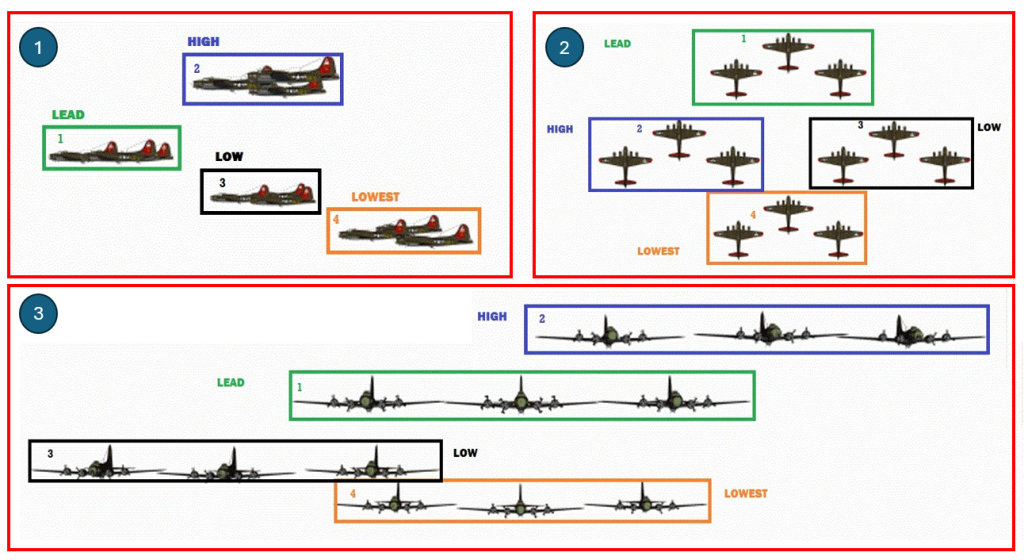
The smallest unit was the element — three aircraft flying in a tight wedge. The lead aircraft flew slightly ahead, with one aircraft stepped up and to the right and another stepped down and to the left. From directly behind, the three aircraft occupied three different altitudes, denying an attacking fighter a clean angle on any single plane without exposing itself to fire from the others.
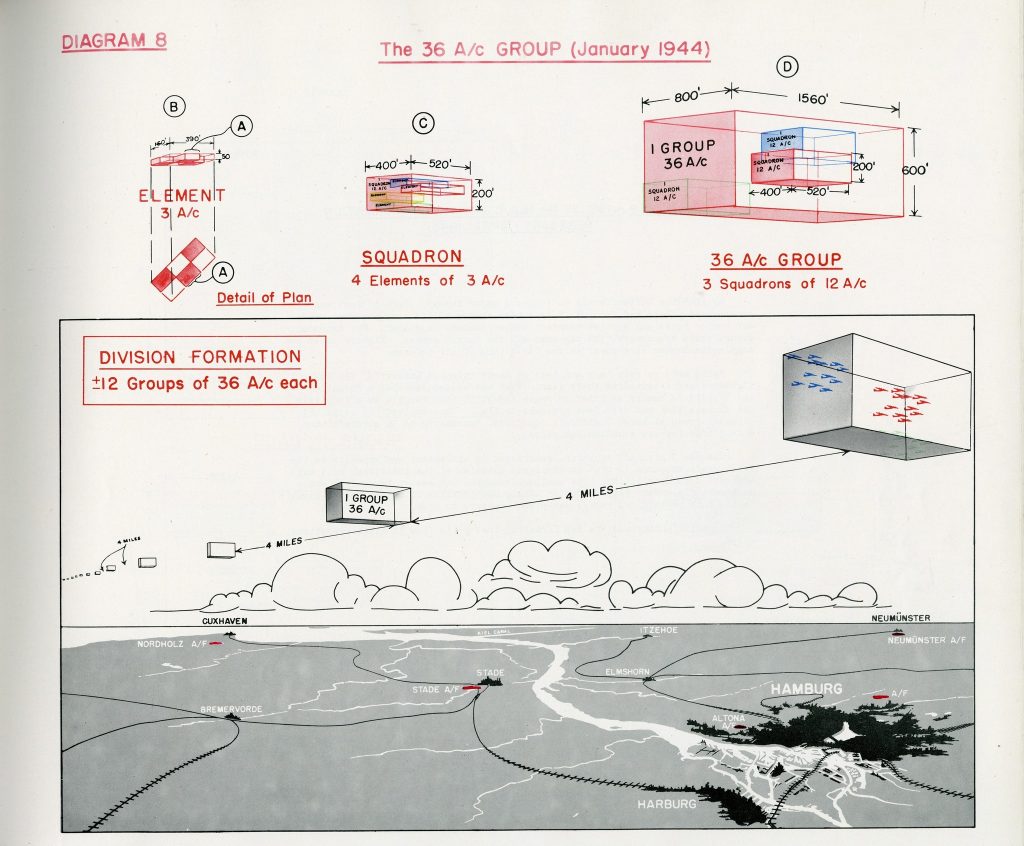
Three elements of three aircraft formed a squadron of nine — sometimes twelve — aircraft. Four elements, in the formation that became standard by early 1944, were arranged in the staggered box that became the signature shape of 8th Air Force operations. Each squadron occupied a three-dimensional block of sky approximately 400 feet wide and 200 feet deep, with aircraft spread across different altitudes within that block.
Three squadrons — lead, high, and low — formed the group of 36 aircraft. The group box occupied a block of sky 1,560 feet wide, 800 feet deep front to back, and 600 feet from the highest aircraft to the lowest. Within that box, the fields of fire of 36 aircraft overlapped continuously. A fighter attacking from any direction would fly through the combined fire of dozens of .50 calibre guns.
The Division Formation — When the Sky Was Full
On a maximum effort day — the Christmas Eve 1944 mission that the 487th led, for example, when 2,046 bombers took the air simultaneously — individual groups were assembled into wings, and wings into divisions, each group separated from the next by approximately four miles. The 3rd Air Division, to which the 487th belonged, could put twelve groups into the air on a single mission: 432 aircraft, stretching across perhaps fifty miles of sky, each group’s defensive envelope overlapping with those ahead and behind.
To stand on the ground at Station 137 on such a morning — as thousands of Suffolk civilians did — and watch this armada assemble overhead was an experience that left a permanent impression on everyone who witnessed it. The sound alone, described by those who heard it as a continuous rolling thunder that lasted for hours, can barely be imagined today.
The Cost of the Formation
The formation was not without its own terrible logic. Tight formation flying required intense concentration from pilots already managing a four-engined heavy bomber at 25,000 feet in freezing temperatures, wearing oxygen masks, often under fire. It demanded that aircraft maintain position even when damaged — because a straggler who fell out of formation was immediately set upon by fighters who had been waiting for exactly that opportunity. The decision to stay in formation or drop out was sometimes the most consequential decision a pilot made on a mission, and the consequences of dropping out were often fatal.
It also meant that when flak found a formation, it found multiple aircraft simultaneously. The carefully calculated spacing that protected against fighters also meant that a well-aimed flak burst — detonating in the middle of a tight squadron box — could damage several aircraft at once. The formation that kept you alive against fighters could kill you over the target.
The men who flew from Lavenham understood this arithmetic intimately. They flew the formation anyway, mission after mission, because the alternative was worse.
Walking the Runway
The perimeter track that visitors walk on our summer guided tours is the same concrete from which those formations departed. The hardstandings where you can still see the outline of where individual aircraft were parked — each one a B-17 that would taxi out in the pre-dawn darkness, join the queue, and wait its turn to take off into an English morning — are still visible in the landscape.
On a quiet Suffolk afternoon it takes some effort of imagination to place four dozen heavy bombers on this peaceful farmland. But they were here, and the ground remembers them.
Leave a Reply